Best Dating Apps in 2026: An Honest Comparison
An honest, no-PR comparison of the best dating apps in 2026 — what each one is actually good for, who it's right for, and where each one falls short.
Dating-app comparison content is usually awful — sponsored posts disguised as reviews, or rage-bait articles where every app is bad. Here’s an honest version.
The mechanic-first framing
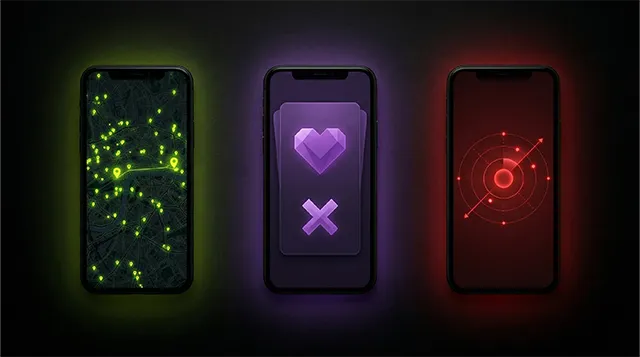
Don’t pick an app by brand. Pick by mechanic. Each mechanic produces a different experience, regardless of which company runs it.
The four major mechanics in 2026:
1. Swipe-based
Examples: Tinder, Bumble, OkCupid (mostly) Mechanic: infinite stack of profile cards, decide yes/no on each. Strengths: scale, ease of use. Weaknesses: dopamine loop, low match-to-meetup conversion, burnout-prone.
2. Prompt-based
Examples: Hinge Mechanic: profiles built from prompted answers, like specific bits of profile. Strengths: deeper signal, conversation starters built in. Weaknesses: still requires you to chat-then-meet across geography.
3. Location-based / map-first
Examples: Mapdate, Happn Mechanic: see real people on a live map, by neighborhood and proximity. Strengths: highest match-to-meetup conversion, anti-burnout structure, real-world context. Weaknesses: lower density in suburban / rural areas.
4. Niche / interest-based
Examples: Feeld, The League, BLK, Coffee Meets Bagel, JSwipe, etc. Mechanic: pre-filtered to a specific demographic or interest. Strengths: better starting compatibility. Weaknesses: smaller user base = longer waits between matches.
The category you pick matters more than the brand within the category.
Honest pros / cons by app
Tinder
- Pro: Largest user base, especially in mid-density cities and travel.
- Con: Optimized for engagement, not meeting. Burnout-prone after 6 months.
- Best for: Travel dating, quick meetup culture in major cities.
Bumble
- Pro: Women-message-first model reduces opening-message spam.
- Con: Same swipe mechanic, same dopamine loop.
- Best for: Users who specifically dislike receiving low-effort opener messages.
Hinge
- Pro: Prompt-based profiles produce deeper signal.
- Con: Recently shifted to more swipe-style behavior in some markets, eroding the advantage.
- Best for: Late-20s+ urban users who want more profile depth.
Mapdate
- Pro: Location-first mechanic. Best match-to-meetup conversion in dense urban areas. Voice notes + public hubs add unique signal layers.
- Con: Smaller in low-density markets.
- Best for: Urban dwellers tired of swipe burnout. Spontaneous dating. Neighborhood-first thinking.
Happn
- Pro: “We crossed paths” mechanic — interesting twist on proximity.
- Con: Mostly retroactive (paths already crossed) rather than active mapping.
- Best for: Commuters, frequent transit-takers, “I see you on my morning run” types.
Feeld
- Pro: Best app for non-monogamous, queer, or non-traditional dating.
- Con: Smaller pool, specific frame.
- Best for: People specifically not looking for monogamous heterosexual dating-as-usual.
The League
- Pro: Verified profiles with professional backgrounds.
- Con: Pricey. Optionality-as-status.
- Best for: Users who specifically value verified credentials in matching.
OkCupid
- Pro: Long-form questionnaire produces compatibility scores.
- Con: Mostly converged with swipe apps in product feel.
- Best for: Users who want depth-of-questions in matching.
How to pick
Three questions:
1. What’s your match-to-meetup conversion looking like?
If you’ve matched 50 people in the last 3 months and met 0-2 of them, you have a structural problem with your current app. Switch mechanic.
If you’ve matched 20 and met 5-8, the app is doing its job. Keep going.
2. How dense is your area?
Major dense city → location-first mechanics (Mapdate, Happn) work best. Mid-density or suburban → swipe / prompt apps still have the volume advantage. Rural → most apps struggle. Travel-friendly mechanics (Tinder when traveling) become more relevant.
3. What does fatigue feel like for you?
If swiping infinitely fatigues you, switch to a finite-feed mechanic. If reading long bios fatigues you, swipe apps suit better. If the empty-conversation fatigue dominates, location-based proximity helps.
What changed in 2026
Several shifts worth noting:
- Verification badges are now standard across major apps. Use them.
- Voice notes went from novelty to expected feature. Apps that don’t have them feel old.
- AI-generated profiles are detectable but increasingly common — apps with stricter verification have an advantage here.
- Location-based and “proximity-first” mechanics moved from niche to category. Mapdate, Happn and a handful of others are no longer experiments — they’re the alternative mechanic.
- Subscription-tiered features (boosts, super-likes, see-who-liked-you) became more central. Users without paid features compete in a slower-moving lane.
TL;DR
- Pick the mechanic before the brand
- Most users on swipe apps for 6+ months would do better on a different mechanic
- Match-to-meetup conversion is the only metric that matters
- Location-first apps win in dense urban areas; swipe apps still have volume in mid-density
- Verification badges + voice notes are 2026 baseline, not bonus features
The “best” dating app is the one whose mechanic matches how you’d actually meet someone. If you’re tired of swiping, the answer isn’t a fourth swipe app.
See it for yourself.
Mapdate is free to download. Live map, real people, real connections.
Keep reading
-

30 First Date Questions That Aren't Boring (And 10 to Avoid)
First date conversation can be brutal if you fall back on the standard questions. Here are 30 first-date questions that actually create connection — and the 10 that kill it.
-
20 Second Date Ideas That Build on the First One
First dates filter for chemistry. Second dates build on it. Here are 20 second-date ideas that level up from coffee-and-questions to actually getting to know someone.
-
30 Date Night Ideas Under $20 (That Don't Feel Cheap)
Cheap date nights have a bad reputation, mostly undeserved. Here are 30 date ideas under $20 each that are genuinely better than another expensive dinner.