How to Write a Dating Profile That Gets Matches in 2026
A practical guide to writing a dating profile that gets real matches in 2026 — what photos to use, what to write in your bio, and what to avoid.
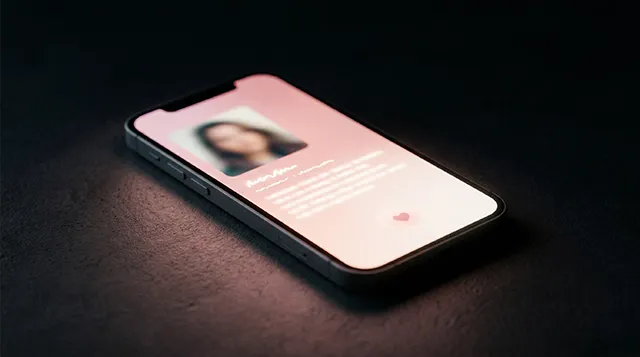
Your dating profile is the first thing someone sees before deciding whether to connect with you. In 2026, with hundreds of millions of profiles competing for attention, the difference between a profile that gets matches and one that gets ignored comes down to a handful of specific choices. Here’s what actually works.
Photos: The 80/20 Rule
Photos account for roughly 80% of the initial decision to engage with a profile. Everything else — bio, interests, prompts — is secondary. Get the photos right first.
Your first photo is everything
Your lead photo should be a clear, well-lit shot of your face. Not a group photo. Not a gym selfie. Not a photo with sunglasses. The person viewing your profile needs to immediately understand what you look like. Anything that introduces ambiguity — dark lighting, distance, obscured face — creates friction and costs you matches.
Show context, not just your face
Your second and third photos should show you doing something. At a concert, hiking, cooking, with friends. Context photos serve two purposes: they signal personality, and they give the other person a conversation starter. A photo with nothing but your face gives them nothing to work with.
What to avoid
- Group photos as your lead image — forces the viewer to guess which person you are
- Photos with an ex — even cropped, awkward energy remains
- Heavy filters — signals inauthenticity and creates disappointment in person
- Photos older than 2–3 years — the person meeting you should recognise you immediately
- Shirtless/bikini as your only photos — works for some, alienates many
Pro tip: Upload 4–6 photos. Profiles with fewer than 3 photos get significantly lower engagement. More photos = more data = more confidence for the person viewing your profile.
The Bio: Short, Specific, Memorable
Most people write bios that are either too long (no one reads them) or too vague (“I love laughing and adventures”). The best bios are short, specific, and give the reader something to respond to.
The 3-line formula
- One specific thing you love — not “I love music” but “I go to at least one live show a month, latest obsession is Khruangbin”
- One thing you do well or care about — actual texture, not a platitude
- One light hook — a question, a quirky fact, something that invites a reply
This structure creates three potential conversation openers without requiring the reader to do much work.
What kills a bio
- “I’m an open book, just ask” — says nothing, gives no reason to ask
- Laundry lists of adjectives: “adventurous, spontaneous, ambitious, loyal”
- Negativity: “not here for hookups”, “if you can’t handle me at my worst…”
- Copying generic phrases that appear on thousands of other profiles
Key insight: Specificity signals authenticity. “I make pretty good tacos” is more compelling than “I love cooking”. The former is a person; the latter is a checkbox.
Interests & Profile Sections
On apps that let you add interests or tags, treat them as conversation hooks, not a resume. Pick 4–6 interests that genuinely reflect how you spend your time, not the ones you think sound impressive.
On Mapdate, your Stories do a lot of this work automatically. A Story showing your Saturday afternoon — what you’re actually doing, where you are — communicates more authentic context than any interest tag. Use them.
The Location Advantage
On a map-based platform like Mapdate, your profile works differently than on a swipe app. The person viewing your profile already knows you’re nearby. That geographic context removes one of the biggest friction points in online dating: the “but we’d never actually meet” problem.
This means your profile can be slightly more casual and direct than it would be on a platform where you might be matching with someone 40 km away. The implicit message is already “I’m close, we could actually meet” — your profile just needs to make that meeting feel worth it.
Update Your Profile Regularly
A profile that hasn’t changed in six months feels stale — to algorithms and to humans. Update your photos seasonally. Refresh your bio when something significant changes in your life. Post new Stories regularly. Active profiles get more visibility and more engagement across all platforms.
Bottom line: A great dating profile is specific, recent, and gives the other person something to respond to. Photos should show your face clearly and your life contextually. Your bio should be short and contain at least one concrete hook. Everything else is refinement.
See it for yourself.
Mapdate is free to download. Live map, real people, real connections.
Keep reading
-
Best Dating Apps in 2026: An Honest Comparison
An honest, no-PR comparison of the best dating apps in 2026 — what each one is actually good for, who it's right for, and where each one falls short.
-
30 First Date Questions That Aren't Boring (And 10 to Avoid)
First date conversation can be brutal if you fall back on the standard questions. Here are 30 first-date questions that actually create connection — and the 10 that kill it.
-
20 Second Date Ideas That Build on the First One
First dates filter for chemistry. Second dates build on it. Here are 20 second-date ideas that level up from coffee-and-questions to actually getting to know someone.