
Mapdate vs Happn vs Tinder: How Map-Based Dating Compares
A side-by-side comparison of Mapdate, Happn, and Tinder. Features, pricing, how location is used, and which app is right for you in 2026.
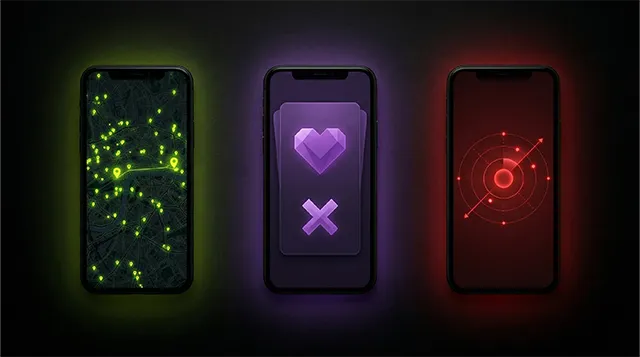
Location-aware dating apps all claim to help you meet people nearby — but they do it in fundamentally different ways. Tinder uses location as a radius filter on a swipe feed. Happn shows you people you’ve physically crossed paths with. Mapdate puts everyone on a live interactive map as the primary interface.
These are not the same product. Here’s a full breakdown.
Feature Comparison at a Glance
| Feature | Mapdate | Happn | Tinder |
|---|---|---|---|
| Core interface | Live map | Cross-paths feed | Swipe stack |
| See people nearby in real time | Yes | Retroactive | No |
| Free to join | Yes | Yes | Yes |
| iOS & Android | Yes | Yes | Yes |
| Stories / mood content | Yes | Limited | No |
| Instant connect without match | Yes (Sparks) | With FlashNote | No |
| Voice notes in chat | Yes | No | No |
| Community / public hub | Yes | No | No |
| Rewards / gamification | Popularity Points | No | Boost only |
| Advanced search filters (free) | Basic (Premium for full) | Premium only | Very limited |
| Premium subscription | 1 / 3 / 6 months | Monthly | Monthly / Annual |
How Each App Uses Location
Tinder: Location as a filter
Tinder uses your location to define a search radius (e.g. “show me people within 50 km”). Beyond that, location plays no role. You’re still swiping through a photo feed with no geographic context. Two people 800 metres apart look identical to two people 45 km apart. The map is invisible.
Result: High volume of matches, low context, slow progression to real-life meeting.
Happn: Location as history
Happn records every time two users physically cross paths and logs those encounters in a reverse-chronological feed. It’s a clever idea — “you crossed paths with this person 3 times this week” — but it’s fundamentally backward-looking. You see who you’ve already encountered, not who is nearby right now. The app is passive: it waits for life to happen and then annotates it.
Result: High serendipity signal, but reactive rather than proactive. Works best in dense urban environments with lots of movement.
Mapdate: Location as the primary lens
Mapdate’s core interface is a live map. Open the app and you see people around you right now. You can zoom in, zoom out, tap on profiles, filter by criteria. Location isn’t a setting you configure — it’s the canvas on which everything happens. This makes the geographic dimension of dating explicit and actionable rather than ambient.
Result: Highest real-time proximity awareness, most direct path from app discovery to in-person meeting.
Content & Self-Expression
Tinder’s profile format has barely changed in a decade: photos, a short bio, maybe some prompts. Happn is similar. Both apps are fundamentally photo-first.
Mapdate adds a Stories layer — you can share your current mood via photo, video, or audio. This is not a permanent portfolio; it’s a live signal. Someone who shares a story about being at a rooftop bar right now is giving you contextual, timely information that a bio photo cannot. It makes self-expression dynamic rather than curated.
Community Features
Neither Tinder nor Happn has meaningful community features. They’re purely 1:1 matching apps.
Mapdate includes a Public Hub — city-wide conversations where you can get noticed and build a presence in your local community. This creates a social layer that sits between “discovering profiles” and “private messaging,” lowering the barrier to initial contact and making the experience feel more like a social network than a match factory.
Pricing Overview
All three apps are free to join with core features. Premium tiers unlock advanced functionality:
- Mapdate: Free core app; Premium Pass available as 1, 3, or 6-month subscriptions. Extra Features (Boosts, Sparks, Flashes) purchasable à la carte.
- Happn: Free with daily likes limit; Premium subscription unlocks unlimited likes and advanced filters.
- Tinder: Free with limited swipes; Tinder Gold / Platinum subscriptions for unlimited swipes, passport, top picks, and more.
Note: Tinder’s premium pricing is significantly higher than both Mapdate and Happn, particularly on iOS, where Tinder Gold can exceed $30/month for new subscribers.
Who Each App Is Best For
Mapdate — best for: proactive, proximity-driven connection
If you want to know who is literally nearby right now and meet people in your real physical world, Mapdate is built for exactly this. Best for people who are tired of the swipe treadmill and want faster progression to real-life meeting.
Happn — best for: serendipity enthusiasts in dense cities
If you love the idea of “we’ve crossed paths 7 times” as a conversation opener and live in a walkable urban environment, Happn’s retroactive model has a romantic appeal. Less useful in suburbs or low-density areas.
Tinder — best for: maximum volume and global reach
Tinder’s user base is unmatched. If sheer volume of potential matches matters more than proximity or context, Tinder delivers. It’s the dating app default — familiar, predictable, and broad.
Our Take
The comparison isn’t really “which app has the best features” — it’s “what theory of dating do you want to subscribe to?” Tinder believes in volume. Happn believes in serendipity. Mapdate believes that knowing someone is around the corner right now is the most powerful match signal available.
As location-based services become more sophisticated and user expectations shift toward real-world connection over digital entertainment, the map-first model has a structural advantage. It’s not just a different UI — it’s a different answer to the question: what makes two people want to actually meet?
See it for yourself.
Mapdate is free to download. Live map, real people, real connections.
Keep reading
-
Best Dating Apps in 2026: An Honest Comparison
An honest, no-PR comparison of the best dating apps in 2026 — what each one is actually good for, who it's right for, and where each one falls short.
-
Map-Based Dating: Why Location-First Beats Swipe-First
Endless swipe feeds are exhausting and gamified. Here's why location-first dating apps like Mapdate — where you see real people on a live map — create more authentic, faster connections.
-
Why Location-Based Dating Apps Work Better Than Swipe Apps
The case for location-based dating: less friction from match to meet-up, higher signal quality, and a structural cure for dating-app burnout.