
Why Location-Based Dating Apps Work Better Than Swipe Apps
The case for location-based dating: less friction from match to meet-up, higher signal quality, and a structural cure for dating-app burnout.
Most online-dating advice treats “the dating app problem” as a personality issue. Wrong angle. The product mechanic shapes the experience more than personality does — and after a decade of swipe apps, the problems are structural.
Here’s why location-based dating apps work materially better.
1. Proximity drives commitment
On a swipe app, the average match is geographically arbitrary. You can match with someone 25 km away, schedule a date, then realize neither of you actually wants to commute to it. Match dies.
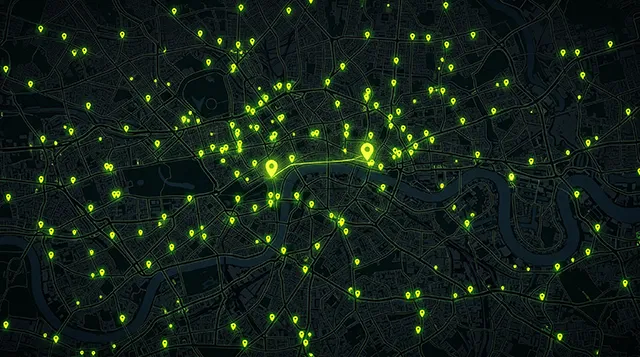
On a location-based app, you only see people who are physically nearby — your block, your neighborhood, your neighborhood’s neighborhood. Every match has built-in geographic feasibility. Match → coffee tomorrow is the default path, not the exception.
The match-to-meetup conversion rate is the only metric that matters in a dating app. Proximity-first apps win it by structure, not by user effort.
2. The infinite-feed dopamine loop is broken
Swipe apps optimize for swipe count. The best month for the company isn’t the month you find a partner — it’s the month you swipe 4,000 times.
Location-based apps don’t have an infinite feed. The map is finite. You can see all the people in your area. Once you’ve seen them, you’ve seen them. There’s nothing to “swipe through” except the same map you saw yesterday with a few new pins.
This is anti-burnout by design. Your brain doesn’t habituate to a finite map the way it habituates to an infinite feed.
3. Match decisions get more signal
On a swipe app, you decide on photos and 1-2 sentences. That’s almost no information.
On a location-based app, you decide on photos + bio + neighborhood + their movement pattern over a few days + sometimes voice notes + sometimes public hub interactions. Way more signal.
Higher-signal decisions produce better matches. It’s not subtle.
4. Spontaneity is built in
The classic dating-app failure mode: match Monday, chat-ping-pong Tuesday-Thursday, schedule for “next weekend”, weekend gets cancelled, match dies.
Location apps short-circuit this. “I’m at [bar nearby] right now, want to grab a quick drink?” is a sentence that only makes sense on an app that knows where you both are. It’s also the highest-converting message format in dating, full stop.
5. Public-context interaction filters the obvious bad actors
Most location-based apps include a public city-wide hub or chat. Before you DM someone, you can see how they behave in front of other people in their city.
This filters out the dating-app personality that doesn’t survive a public moderated context — the love-bombers, the negging accounts, the off-app pressure profiles. You can spot them before you ever match.
This is what swipe apps were missing for a decade. Behavior in private DMs is a black box; behavior in a city-wide public chat is observable.
6. The map IS the icebreaker
The hardest thing on a swipe app is the first message. The bar is high (avoid “hey”, be specific, be funny, don’t overshare).
On a location app, the map provides the conversation starter. “How’s [their neighborhood] today?” “Have you been to [the cafe their pin is near]?” “Wait, you’re at [event] right now?” The geography makes opening trivial.
7. Real-life context matters
Dating doesn’t happen in a void. It happens in a neighborhood, with venues, with weather, with a Tuesday-night calendar. Apps that ignore that context lose half the signal of how a relationship would actually start.
Apps that integrate location, time and physical context — when they work — feel less like a marketplace and more like an organic discovery tool. Closer to “I noticed you at the same coffee shop” than “the algorithm presented you to me.”
The honest tradeoffs
Location-based apps have downsides. They surface fewer matches in low-density areas. They require bigger user bases per zip code to be useful. They’re harder to build and harder to make work in suburbs.
In dense urban areas with healthy user bases, they’re materially better. In low-density areas, the math doesn’t always work.
The case for trying one
If you’ve been on swipe apps for over a year and feel burned out, the structural fix isn’t a fourth swipe app — it’s a different mechanic. The location-based mechanic is the obvious alternative, and it’s the one solving the right problems.
Mapdate, Happn and a small handful of others run this category. The category is small but it’s the right shape for how dating actually works.
TL;DR
- Swipe apps optimize for swipe count; location apps optimize for meet-ups
- Proximity = automatic commitment to date logistics
- No infinite feed = no burnout dopamine loop
- More signal per match = better matches
- Public hub = behavior filtering before DMs
- Map = built-in icebreaker
The match-to-meetup conversion rate is the only thing worth measuring. Location-based apps win it by mechanic, not by user effort.
See it for yourself.
Mapdate is free to download. Live map, real people, real connections.
Keep reading
-
Best Dating Apps in 2026: An Honest Comparison
An honest, no-PR comparison of the best dating apps in 2026 — what each one is actually good for, who it's right for, and where each one falls short.
-

Modern Dating Fatigue: Why Everyone Feels It and How to Push Through
Modern dating fatigue isn't a personal weakness — it's a structural condition. Here's why it happens, what makes it worse, and the small habits that fix it.
-
How Mapdate Works: The Complete Guide
A complete step-by-step guide to Mapdate — from setting up your profile to sending your first Spark. Learn every feature of the map-based dating app.